AI-Assisted Web Development
Turning creative and professional requirements into working digital interfaces with AI assistance, under human control.
Context
A portfolio strand covering how AI-assisted development is used to take creative and professional requirements through to working, maintained web interfaces.
Question / Challenge
How much of an interface can be built with AI assistance while structure, content, testing and visual direction stay under human control?
My role
Requirements, information architecture, content, visual direction, review and testing.
Process
- Define the audience, structure and content before any code is written.
- Set the design system and typographic rules, then hold implementation to them.
- Use AI assistance for implementation of defined components and layouts.
- Read, test and correct the output; rewrite anything that does not match the intent.
- Check accessibility, responsiveness and content accuracy before release — keyboard focus, skip link, semantic structure, reduced motion, and layouts at 1440, 1024 and 390px.
AI contribution
Implementation assistance across markup, styling and component structure.
Human judgement
Architecture, copy, design system and every accessibility and accuracy decision. Generated copy containing unverifiable claims was removed.
- Requirements and information architecture
- Content and copy
- Art direction
- Accessibility review
- Testing and correction
- Final decision
- Implementation assistance
- Component drafting
- Structuring
Output
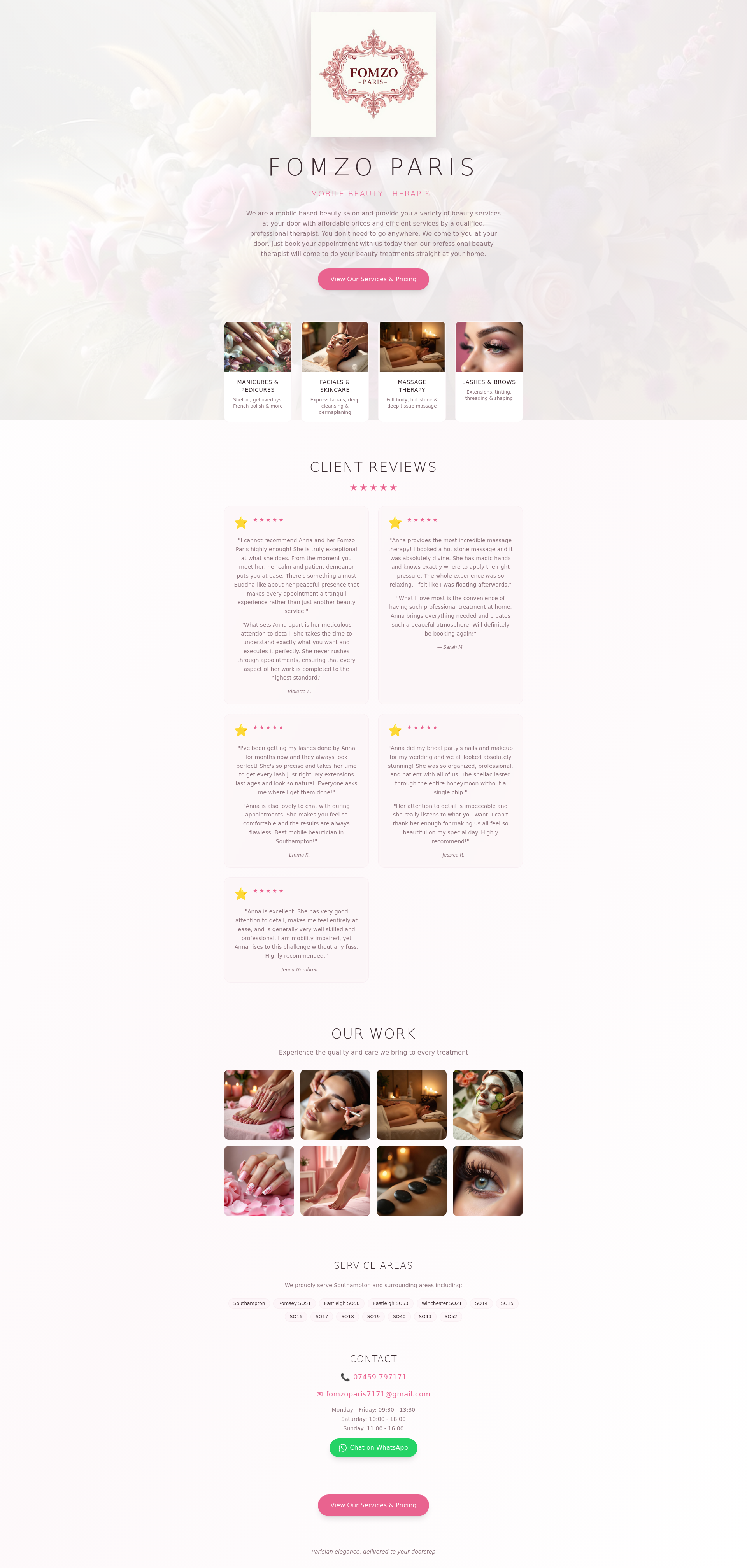
Working sites, including this portfolio — built in Lovable with AI-assisted implementation on a TanStack Start and TypeScript architecture, with responsive layouts checked at 1440, 1024 and 390px, a skip link, semantic structure, visible keyboard focus and reduced-motion support — alongside an earlier personal portfolio and Fomzo Paris, a client-facing beauty-services website.
AI disclosure
- Lovable, with AI-assisted implementation across a TanStack Start and TypeScript codebase.
- To move from defined requirements to working interfaces without a development team.
- Rendered output, responsive behaviour at 1440, 1024 and 390px, keyboard access and focus states, reduced-motion behaviour, and the factual accuracy of all site copy.
- Invented copy and unsupported claims, inconsistent use of the design system, and accessibility details such as labelling and focus states.
- All fabricated content; any styling that broke the established design tokens.
- Structure, content, visual direction, accessibility and final review.
- AI assistance in building these sites is stated openly. No client outcomes or metrics are claimed.
Reflection
AI assistance shortens implementation; it does not shorten the decisions. The review step is where the work actually is.